
Managing annual filing and corporate secretary obligations in Singapore doesn’t require a large compliance department, but it does require a reliable system. If these tasks keep slipping through the cracks in your small team, you’re not alone, and you’re not without options. The key is understanding exactly what’s due, when it’s due, and whether you should handle it in-house or hand it off entirely.
Singapore’s Accounting and Corporate Regulatory Authority (ACRA) oversees more than 600,000 registered business entities, the majority of which are private limited companies. That volume means ACRA can’t afford leniency, and small companies can’t assume they’ll fly under the radar. The compliance machine is automated, penalties are real, and strike-offs happen.
Here’s what you actually need to know.
What Are the Core Filing Obligations for a Singapore Private Limited Company?
Every Singapore-incorporated private limited company must meet a defined set of statutory obligations each year. Miss any of them and you’re exposed to fines, director liability, or worse – company strike-off.
The most pressing obligation is the Annual Return filed with ACRA. Under Section 197 of the Singapore Companies Act (Cap. 50), a private company must file its Annual Return within seven months of its financial year end. Listed companies face a tighter five-month window. Separately, you’ll need to file corporate tax returns (Form C or Form C-S) with IRAS, typically by 30 November each year.
A common and expensive mistake: many small teams confuse the AGM exemption with a filing exemption. Since the Companies (Amendment) Act 2014, private companies that send financial statements to members within five months of their financial year end are exempt from holding an Annual General Meeting. But the Annual Return obligation remains absolute.
What Happens If You Miss a Filing Deadline in Singapore?
Late or non-filing triggers automatic penalties that escalate quickly. Directors and the company secretary face default fines of up to S$5,000 per offence upon conviction under the Companies Act, with continued daily penalties for ongoing non-compliance (Singapore Companies Act, Cap. 50, s.197). ACRA also holds the power to strike off companies that persistently fail to meet their obligations.
On the tax side, IRAS penalties for late filing of Form C/C-S can take the form of an offer of composition of up to S$5,000. For more serious offences, such as failure to attend court, there may be fines of up to S$10,000 per offence imposed on the company director.
These aren’t theoretical risks. ACRA actively monitors compliance through its BizFile+ system, and enforcement actions are routine.
How Soon Must You Appoint a Corporate Secretary?
Within six months of incorporation. No exceptions.
Section 171 of the Companies Act mandates that every Singapore-incorporated company must appoint a qualified company secretary within six months of incorporation. The position cannot remain vacant for more than six months at any time thereafter. The secretary must be a natural person ordinarily resident in Singapore as a foreign-based individual or a nominee director alone won’t satisfy the requirement. Failure to appoint carries a default fine of up to S$5,000.
Many bootstrapped startups push this appointment down their priority list without realising it’s a day-one legal obligation with a hard deadline.
Should You Handle Compliance In-House or Outsource It?
For most small teams, outsourcing is the smarter path. Here’s why.
| Factor | In-House | Outsourced Corporate Secretary |
|---|---|---|
| Expertise | Requires ongoing training on regulatory changes | Provider stays current with ACRA and IRAS requirements |
| Deadline tracking | Falls on founders or operations staff | Handled by the provider with automated reminders |
| Liability risk | Higher – missed deadlines are common in lean teams | Lower – contractual accountability sits with the provider |
| Scalability | Difficult without hiring | Scales with your company’s complexity |
What Does a Corporate Secretary Actually Do?
The role goes well beyond filing paperwork. A qualified corporate secretary ensures your company maintains proper statutory registers, prepares and files Annual Returns, manages board resolutions and minutes, and keeps your registered particulars current with ACRA.
They also act as your first line of defence when regulations change. Singapore’s corporate compliance framework evolves regularly, and a competent secretary will flag new requirements before they become problems for your business.
Think of it this way: you wouldn’t skip bookkeeping and hope the tax return sorts itself out. The same logic applies to corporate governance.
A Simple Annual Compliance Calendar for Singapore Companies
Staying on track gets easier once you map obligations to your calendar. Here’s a stripped-down version:
- Financial year end — trigger date for all subsequent deadlines
- Within five months of FYE — send financial statements to members (to qualify for AGM exemption)
- Within seven months of FYE — file Annual Return with ACRA via BizFile+
- By 30 November each year — file Form C/C-S with IRAS
- Ongoing — maintain statutory registers, update ACRA on changes to directors, shareholders, or registered address within 14 days
Frequently Asked Questions
Can a sole director also serve as the company secretary?
No. Under the Companies Act, a sole director of a company cannot simultaneously serve as its secretary. You must appoint a separate qualified individual who is ordinarily resident in Singapore.
Is the Annual Return the same as filing taxes?
They’re entirely separate obligations. The Annual Return is filed with ACRA and covers corporate particulars and financial statements. Tax returns (Form C/C-S) go to IRAS. Missing either carries distinct penalties.
What if my company has had no business activity — do I still need to file?
Yes. Dormant companies must still file their Annual Return with ACRA and submit tax returns to IRAS. There is no exemption based on inactivity, though simplified filing options such as Form C-S may apply.
How do I know if my corporate secretary provider is qualified?
A qualified corporate secretary in Singapore should be a member of a professional body such as the Singapore Association of the Institute of Chartered Secretaries and Administrators (SAICSA), or hold equivalent qualifications recognised under the Companies Act. Always verify their credentials and ensure they are a natural person ordinarily resident in Singapore.
At what point should a growing company bring compliance management in-house?
Most companies find outsourcing sufficient until they reach a level of complexity – multiple subsidiaries, frequent share transfers, or regulatory interactions – that justifies a dedicated in-house hire. For the vast majority of SMEs, a reliable outsourced provider remains the more cost-effective and lower-risk option.
Suggested Readings
 How to Register a Private Limited Company in Singapore as a Foreigner: A Practical Guide for 2026
Handling Employment Pass Appeals in Singapore: A Startup’s Practical Guide
How to Register a Private Limited Company in Singapore as a Foreigner: A Practical Guide for 2026
Handling Employment Pass Appeals in Singapore: A Startup’s Practical Guide
 For Singapore Company Incorporation, Appointing the Right Company Secretary and Resident Director is Most Important
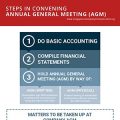 How To Convene an Annual General Meeting (AGM)